
Project archive guide. Technical instructions are awaiting hardware-team review; consult the documentation for your exact equipment.
FPV Cameras
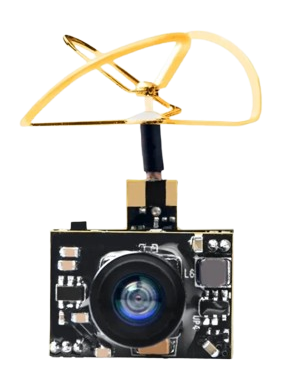
Your FPV camera is your eyes in the sky. It captures live video and sends it to your goggles, letting you fly as if you were sitting inside the drone. Choosing the right camera and knowing how to adjust its settings can make a huge difference in clarity, reaction time, and overall flight experience.
Key Vocabulary
Field of View (FOV)
How much of the scene the camera captures, measured in degrees.
Latency
The delay between what happens in real life and what you see in the goggles.
Resolution
The sharpness and clarity of the video image.
Dynamic Range
The camera’s ability to show detail in both bright and dark areas at the same time.
Lens Type
The shape and size of the lens, which changes how zoomed in or wide the view appears.
Low Light Performance
How well the camera captures clear video in dim lighting.
Dig Deeper
Field of View (FOV)
FOV controls how much you can see through your FPV goggles. Wide FOV (e.g., 160°) gives a big, panoramic view so you can spot obstacles and judge speed better, but it can make objects look smaller and farther away. Narrow FOV (e.g., 120°) makes objects look closer and more detailed, but you lose peripheral vision, which can make high-speed cornering trickier.
Latency
This is the time it takes for the video signal to travel from your camera to your goggles. Low latency (under 20ms) is essential for racing and acrobatic flying where every split-second counts. Higher latency is fine for slow, cinematic flights but can feel “laggy” at high speeds.
Resolution
Resolution determines how sharp your video looks. Analog FPV is usually 480p–720p, giving a slightly fuzzy image but very fast signal transmission. Digital FPV can reach 1080p or more, giving crisp detail for spotting gaps or branches, but may slightly increase latency.
Dynamic Range
Dynamic range decides how well your camera balances bright and dark parts of the image. High dynamic range lets you fly from sunny areas into shadows without losing visibility in either area. Low dynamic range can make shadowy spots look black or sunny areas look washed out.
Lens Type
FPV cameras use fixed lenses, measured in millimeters. Lower mm (e.g., 1.8mm) = wider view, better for freestyle and close-range flying. Higher mm (e.g., 2.5mm) = narrower view, better for precision racing.
Low Light Performance
If you fly at night, indoors, or during sunset, low light performance matters. Good low-light sensors keep your feed clear in dim conditions and adjust quickly when moving between bright and dark areas. Poor low-light cameras may get grainy or too dark to see obstacles.
Two Types of FPV Cameras
Digital
Provides HD video with crisp detail and low latency, offering a clear and immersive flying experience.
Analog
Offers lower resolution but ultra-low latency and better signal penetration.
Analog Vs Digital FPV Cameras
Latency
Analog: Extremely low latency (~5–20ms), great for fast-paced flying where instant feedback is critical.
Digital: Slightly higher latency (~20–40ms), but still low enough for most pilots and offers better image quality.
Resolution
Analog: Standard definition around 480p–720p, which is sufficient for quick reactions but less detailed.
Digital: High definition up to 1080p and beyond, providing crisp images that help spot small obstacles and terrain details.
Signal Range
Analog: Generally offers longer range with simpler transmitters and receivers.
Digital: Typically shorter effective range but improving quickly with new technology.
Image Quality
Analog: Grainier and more prone to interference, but reliable and very fast.
Digital: Cleaner, sharper image with less noise, enhancing flying experience, especially in complex environments.
Weight & Cost
Analog: Generally lighter and more affordable, making them great for budget and lightweight builds.
Digital: Heavier and more expensive, but the gap is closing as tech evolves.
Overall
Analog is perfect for pilots who prioritize speed and reliability, especially in racing and freestyle.
Digital appeals to pilots who want stunning visuals and can accept a small latency increase for that clarity.